AI-Powered Clinic Management App — Business Models & Development Cost Guide
- digital brain
Introduction
Imagine walking into a clinic. Instead of waiting in long queues and juggling files, the receptionist checks you in with one click. Your doctor already knows your medical history, prescriptions are instantly shared on your phone, payments happen digitally, and you even receive a reminder for your next visit automatically.
This is not science fiction — it’s the future of healthcare, driven by AI-powered clinic management apps.
The Big Idea — Why Build an AI-Powered Clinic Management App?
Healthcare is one of the most important yet complex industries. Clinics, especially small to medium ones, often face these challenges:
- Long waiting times for patients.
- Overworked doctors and staff.
- Paper-based or outdated record systems.
- Inefficient billing and payment processes.
- Lack of personalized patient care.
An AI-powered digital clinic management system solves all these problems. It streamlines operations, improves patient satisfaction, and helps clinics grow sustainably.
Think of it as giving clinics their own digital superpower — a system that organizes appointments, maintains records, assists doctors with decision-making, automates billing, and even predicts patient health risks.
Why Start This Business?
- Massive Demand: Post-COVID, telemedicine, and digital health solutions saw exponential growth. Clinics now realize digital tools are no longer optional.
- Recurring Revenue: With a subscription-based model, clinics pay monthly or yearly fees. This creates a stable cash flow for businesses.
- Scalability: Once the platform is built, scaling from 10 clinics to 1,000 clinics requires minimal additional cost.
- Profitability: Software margins are high. Once developed, the same system can be licensed across multiple clinics.
- Social Impact: Beyond profits, this business improves healthcare delivery, saves lives, and increases accessibility.
Business Models:
Subscription (SaaS)
- Clinics pay monthly or yearly fees to use the app.
- Example: ₹2,000 per clinic/month.
- Pros: Predictable recurring revenue.
- Cons: Requires retention and customer support.
Commission-Based
- The app takes a percentage of each consultation, booking, or payment processed.
- Example: 5% on each online consultation fee.
- Pros: Scales with patient usage.
- Cons: Revenue depends on clinic activity.
Freemium
- Basic app is free, but premium features (AI reports, analytics, additional staff access) require payment.
- Pros: Easy adoption.
- Cons: Only a fraction of users upgrade to premium.
One-Time License
- Clinics purchase lifetime usage with a one-time fee.
- Example: ₹5–10 Lakhs per clinic.
- Pros: Large upfront income.
- Cons: No recurring revenue.
Advertising & Cross-Selling
- Clinics can promote partner services like diagnostic labs, insurance, or pharmacy products within the app.
- Pros: Additional income stream.
- Cons: Risk of disrupting user experience.
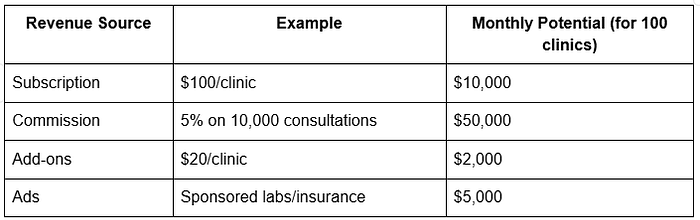
Revenue Model Examples

With combined models, a well-built clinic management platform could generate $70,000+ per month even with just 100 active clinics.
Global Market Leaders
USA
- DrChrono — $30M+ annual revenue.
- AthenaHealth — Revenue exceeds $1.3B, serving thousands of clinics.
- Kareo — Specializes in small-practice management.
Europe
- Doctolib (France) — Valuation over $1B, serving millions of patients.
- CompuGroup Medical (Germany) — A global leader in healthcare IT.
India
- Practo — Popular telemedicine and clinic management platform.
- HealthPlix — Focuses on AI-powered doctor workflows.
- MediBuddy — Integrates teleconsultation with health insurance.
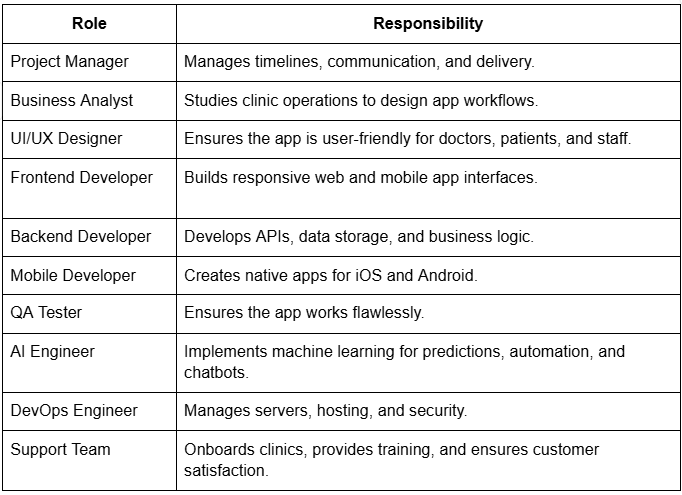
Team Required to Build an AI-Powered Clinic App
Development Cost
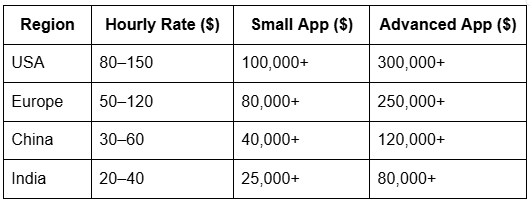
India offers the best balance of cost and quality. Many global healthcare apps are already developed here.
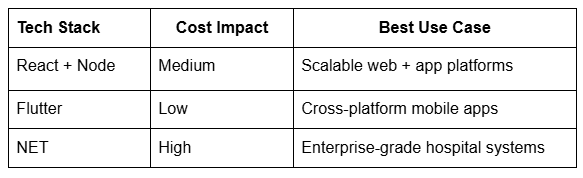
Technologies for Best Development
- Frontend: React, Angular, Flutter
- Backend: Node.js, Django, .NET
- Database: PostgreSQL, MongoD
- AI Frameworks: TensorFlow, PyTorch
- Hosting: AWS, Azure
White-Label vs Custom Development
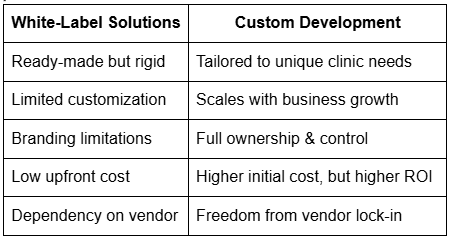
White-label is like renting an apartment — it’s fast and affordable but never truly yours. Custom development is like building your own home — more investment upfront, but built exactly to your needs and grows with you.
The Role of AI in Clinic Management
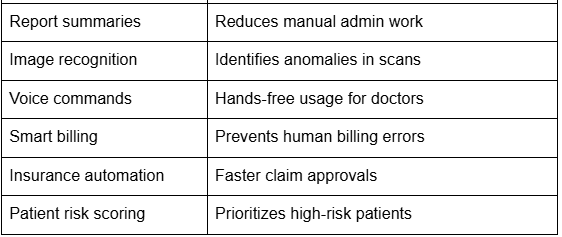
AI transforms the clinic experience from reactive to proactive. It reduces human error, improves efficiency, and ensures better patient outcomes.
20 Benefits of AI Integration


Freelancer vs Agency
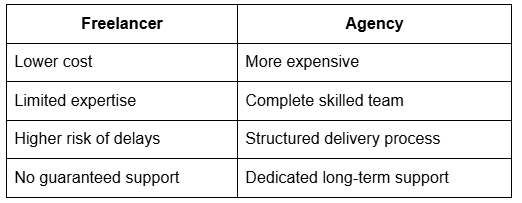
Agencies are more reliable for healthcare apps because they bring stability, accountability, and scalability.
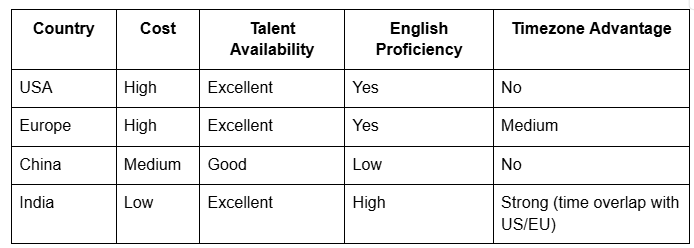
Why Outsource to India?

India offers cost-effectiveness, world-class engineers, and excellent communication skills — making it the top outsourcing destination.
Why Outsource to Digital Brain Media?
At Digital Brain Media, we go beyond coding. We act as your strategic partner in building healthcare solutions.
Our proven model:
- Understand client needs and workflows.
- Design wireframes and prototypes.
- Use Agile methodology for step-by-step progress.
- Share weekly updates for transparency.
- Conduct rigorous testing before launch.
- Provide continuous post-launch support.
This ensures your clinic management app is built on time, on budget, and at world-class standards.
Frequently Asked Questions (FAQ)
Q1: How much time does it take to build an AI-powered clinic management app?
Typically, 4–6 months for a basic MVP (Minimum Viable Product), and 9–12 months for a fully advanced system with AI, telemedicine, and insurance integration.
Q2: Can small clinics also afford such apps, or is it only for big hospitals?
Yes! SaaS subscription models start as low as $50–$100 per month. Small clinics often see ROI quickly because of reduced paperwork, faster patient processing, and higher patient retention.
Q3: Is AI safe for handling sensitive patient data?
Absolutely, as long as the app complies with HIPAA (USA), GDPR (Europe), and NDHM standards (India). Data encryption, role-based access, and secure cloud hosting make it safer than paper files.
Q4: Do doctors really trust AI?
Doctors don’t see AI as a replacement but as an assistant. AI saves time by automating repetitive tasks — like transcriptions, scheduling, and reminders — so doctors focus more on patients.
Q5: Can the app be integrated with existing hospital software?
Yes. Through API integration, the system can connect with lab software, pharmacy systems, or billing solutions already in place.
Q6: What’s the biggest mistake clinics make when adopting such apps?
Relying only on white-label solutions that don’t match their workflow. Customization is key to long-term success.
Q7: What kind of revenue can I expect from this business?
Depending on your model, revenue can range from $10K/month (with 100 clinics) to $100K+/month (with 1,000 clinics).
Q8: How do I choose the right development partner?
Look for experience in healthcare apps, proven case studies, transparency in pricing, and strong post-launch support.

Build Your Digital Presence Today!
References
- Statista (2023) — The global healthcare IT market is projected to exceed $900 billion by 2030
http://www.statista.com/statistics/1214993/healthcare-it-market-size-worldwide/ - Fortune Business Insights (2023) — The AI in healthcare market will grow at a CAGR of 42% from 2023–2030
https://www.fortunebusinessinsights.com/industry-reports/artificial-intelligence-ai-in-healthcare-market-100753 - McKinsey & Company — AI can help reduce healthcare administrative costs by up to $150 billion annually in the US
https://www.mckinsey.com/industries/healthcare/our-insights/how-artificial-intelligence-will-impact-healthcare - World Health Organization (WHO) — Digital health solutions improve efficiency and accessibility in developing countries
https://www.who.int/publications/i/item/9789240020924 - NDHM, India (National Digital Health Mission) — Government initiative promoting digital health records and e-clinic adoption nationwide
https://ndhm.gov.in/