
iOS app development is the process of creating applications for Apple’s mobile operating system, iOS, which powers devices like the iPhone, iPad, and iPod Touch. These apps are built using programming languages such as Swift or Objective-C, and are developed within Xcode, Apple’s official integrated development environment (IDE).
iOS apps are known for their high performance, security, and premium user experience. Developers must follow Apple’s strict design and functionality guidelines to get their apps approved on the App Store, which ensures consistency and quality across the platform.

1.1 High Revenue Generation
iOS apps contribute to over 65% of global mobile app revenue, with users spending significantly more on in-app purchases and subscriptions than Android users.
1.2 Premium User Base
iOS dominates in developed markets like the USA, Canada, Western Europe, and Japan, attracting high-income, tech-savvy users who prefer quality apps and services.
1.3 Strong Market Share in Key Regions
iOS holds over 55% market share in the U.S. and maintains a strong presence in enterprise, healthcare, fintech, and lifestyle app segments.
1.4 Developer-Friendly Ecosystem
Apple provides powerful tools like Swift, Xcode, and ARKit, allowing developers to build secure, high-performance, and feature-rich applications efficiently.
1.5 Steady Growth & Innovation
The iOS app market continues to grow with trends like AI integration, AR/VR, wearable tech, and subscription-based models, keeping it at the forefront of mobile innovation.
Key Trends:
2.1 AI & Machine Learning Integration
iOS apps are increasingly leveraging Apple’s Core ML and third-party AI tools for personalization, automation, predictive analysis, and intelligent features (e.g., Siri integration, smart assistants).
2.2 AR and VR Experiences
With ARKit, Apple is pushing Augmented Reality into gaming, education, retail, and real estate apps, transforming user interaction and visualization.
2.3 Wearable & Cross-Device Integration
Development for Apple Watch, iPad, Apple TV, and Vision Pro is rising. iOS apps now offer seamless multi-device experiences via Handoff, Continuity, and Universal Apps.
2.4 Subscription-Based Monetization
More developers are adopting recurring revenue models (e.g., freemium + premium subscriptions), especially for fitness, streaming, productivity, and utility apps.
2.5 Enhanced Privacy & Security Features
iOS apps must comply with Apple’s strong data privacy policies (e.g., App Tracking Transparency, on-device processing), making user trust a competitive advantage.
Loyal & High-Spending User Base
iOS users are known for higher lifetime value (LTV) and a greater willingness to pay for premium apps and services.
2.1.1 Strong Developer Tools & Ecosystem
Apple offers a stable SDK, powerful APIs (Swift, Swift UI), and frequent OS updates, enabling developers to innovate rapidly.
2.2.2 Business Demand for High-Quality Apps
Enterprises and startups targeting affluent users or advanced features prefer iOS for its consistent performance, design standards, and security.
2.2.3 5G & Edge Computing
Faster internet speeds enhance the performance of video streaming, gaming, AR, and cloud-based applications on iOS devices.
2.2.4 Focus on User Experience (UX)
Apple’s strict App Store guidelines encourage quality, speed, and usability—driving developers to create polished, responsive, and accessible apps.

Apple enforces rigorous review policies, making it harder for apps with poor UI, limited functionality, or unclear privacy policies to get approved.
3.2 High Development Costs
iOS app development often requires specialized skills, frequent updates, and compliance testing, leading to higher initial and maintenance costs compared to Android.
3.3 Limited Customization & Flexibility
Apple’s closed ecosystem restricts developers from customizing the OS or deeply integrating certain third-party tools, limiting innovation in some areas.
3.4 Device Fragmentation Within Apple Ecosystem
Although less than Android, supporting multiple Apple devices (iPhone, iPad, Watch, Vision Pro) with different screen sizes and hardware capabilities still requires extra effort.
3.5 Ongoing Adaptation to Privacy Rules
Apple’s growing focus on user data protection (like App Tracking Transparency) impacts ad-based revenue models, requiring developers to explore alternative monetization strategies.
Key Opportunities:
3.1.1 High Monetization Potential
iOS users are more likely to pay for apps, subscriptions, and in-app purchases, making it ideal for premium and B2C business models.
3.2.2 Growing AR & AI Ecosystem
With tools like ARKit and Core ML, developers can create futuristic experiences in education, gaming, retail, and healthcare.
3.3.3 Expansion into Wearables & VisionOS
Building apps for Apple Watch, Vision Pro, and HealthKit opens up opportunities in fitness, wellness, and immersive experiences.
3.4.4 Global Reach via App Store
The App Store offers access to over 175 countries, allowing even small startups to reach high-value global audiences with minimal distribution overhead.
3.5.5 Enterprise App Growth
Demand is rising for custom enterprise iOS apps (e.g., logistics, healthcare, field services) due to the platform’s security, integration with Apple Business Manager, and performance.
4.1 Swift Programming Language
iOS apps are primarily developed using Swift, Apple’s powerful, fast, and safe programming language that simplifies code and improves performance.
4.2 Xcode IDE
Apple’s official Integrated Development Environment (IDE) offers all-in-one tools for coding, designing UI, testing, debugging, and deploying apps.
4.3 Human Interface Guidelines (HIG)
iOS apps follow Apple’s design principles to ensure consistent, intuitive, and accessible user experiences across all Apple devices.
4.4 Robust Security Architecture
Built-in features like App Sandbox, Face ID/Touch ID, data encryption, and App Transport Security (ATS) ensure strong data protection and user privacy.
4.5 App Store Distribution
Apps are distributed through the Apple App Store, reaching millions of users globally with access to analytics, payments, subscriptions, and app review tools.
4.6 Seamless Ecosystem Integration
iOS apps integrate smoothly with other Apple devices and services like iCloud, Siri, Apple Pay, Health Kit, Watch Kit, and Vision Pro, providing rich cross-platform functionality.
4.7 Auto Layout & Interface Builder
Powerful UI tools enable developers to create responsive designs that work perfectly across different screen sizes (iPhones, iPads, etc.).
4.8 Push Notifications & Background Modes
Allows apps to keep users engaged and updated in real-time, even when the app is not active.
4.9 Test Flight for Beta Testing
Developers can use Test Flight to distribute beta versions of their apps to testers before public release, improving quality and feedback collection.
Build Your Digital Presence Today!
6.1 Enterprise-Grade Security
iOS apps are favored by businesses for their robust security features, making them ideal for handling confidential data in sectors like finance, healthcare, and legal services.
6.2 High-End User Demographic
iOS users are generally tech-savvy, loyal, and high-spending, making the platform ideal for businesses targeting premium customers, especially in retail, fintech, and luxury services.
6.3 Better ROI for Paid Apps & Subscriptions
Businesses see higher returns from iOS apps due to higher average revenue per user (ARPU), with users more willing to pay for apps, subscriptions, and in-app services.
6.4 Seamless Integration with Apple Ecosystem
iOS apps integrate smoothly with Apple Watch, iPad, macOS, and Vision Pro, allowing businesses to build cross-device solutions for sales, logistics, productivity, and customer service.
6.5 Enterprise Mobility & Custom Solutions
Many companies develop custom iOS apps for internal use—like employee management, inventory tracking, or field service—to increase productivity and reduce operational costs.
The future of iOS app development is set to be driven by cutting-edge technologies like artificial intelligence, augmented reality, and spatial computing, with Apple’s ecosystem expanding through devices like the Vision Pro and seamless cross-platform integration. Developers will increasingly leverage Swift UI, Core ML, and AR Kit to build apps that are smarter, more immersive, and responsive across iPhone, iPad, Apple Watch, and Mac. As Apple continues to lead in privacy-first design, iOS apps will focus on delivering personalized yet secure experiences. The rise of subscription-based models, enterprise mobility, and wearable tech will also reshape how businesses and users interact with mobile applications. In this rapidly evolving environment, iOS development will remain at the forefront of innovation, offering tremendous opportunities for those ready to embrace the next digital revolution.
8.1 Define Your Objective Clearly
Start with a clear understanding of your app’s purpose—whether it’s for e-commerce, productivity, social networking, or internal enterprise use.
8.2 Choose the Right Development Method
Native Development (Swift/Objective-C): Best for performance, speed, and full access to iOS features. Ideal for apps needing advanced functionality like AR, machine learning, or real-time communication.
Cross-Platform (e.g., Flutter, React Native): Faster and more cost-effective if you’re targeting both iOS and Android, though with limited access to some native iOS features.
8.3 Hire the Right Development Team
Choose experienced iOS developers or a trusted agency that understands Apple’s design guidelines, App Store policies, and user experience standards.
8.4 Focus on User Experience & Design
iOS users expect smooth, elegant, and intuitive apps. Make sure your app design follows Apple’s Human Interface Guidelines to maximize engagement.
8.5 Plan for Maintenance and Updates
The iOS ecosystem evolves quickly. Choose a development approach that allows for easy updates, bug fixes, and adaptation to new iOS versions and devices like Apple Watch or Vision Pro.
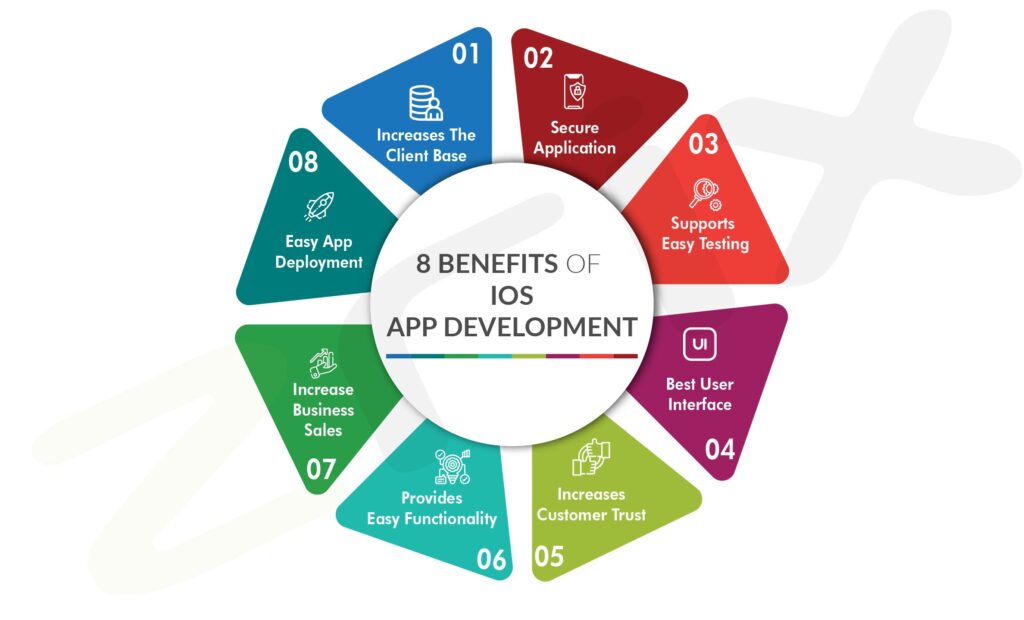
iOS app development offers several key advantages that make it an attractive choice for businesses and developers. One of the most significant benefits is its high-level security and privacy, with robust features like data encryption, Face ID/Touch ID, and strict App Store guidelines, ensuring user trust and data protection. iOS users also tend to be more loyal and willing to spend, resulting in higher revenue potential through in-app purchases and subscriptions. Additionally, the streamlined development process—thanks to fewer device variations and Apple’s optimized hardware-software integration—makes testing and deployment faster and more efficient. iOS apps deliver a superior user experience with consistent design and performance, meeting the expectations of Apple’s premium audience. Furthermore, seamless integration across the Apple ecosystem—including iCloud, Apple Watch, Siri, and Vision Pro—allows for powerful, cross-device functionality that enhances both user engagement and brand value.
10.1 Access to a Premium User Base
iOS users are typically high-income, brand-loyal customers who are more likely to spend on apps, services, and in-app purchases.
10.2 Enhanced Security and Trust
iOS offers advanced security features like data encryption and strict App Store policies, helping businesses build trusted, secure applications.
10.3 Superior User Experience
Apple’s design standards ensure apps are smooth, fast, and user-friendly, increasing customer satisfaction and retention.
10.4 Higher ROI and Revenue Potential
With better monetization models—subscriptions, freemium, in-app purchases—iOS apps generate more revenue than most other platforms.
10.5 Seamless Integration Across Devices
iOS apps work effortlessly across the Apple ecosystem (iPhone, iPad, Apple Watch, Vision Pro), enabling businesses to offer unified digital experiences.
10.6 Advanced Development Tools
Apple’s frameworks like SwiftUI, ARKit, Core ML, and HealthKit allow developers to build innovative, future-ready solutions.
10.7 Ideal for Enterprise Mobility
Businesses can develop custom iOS apps for internal use (e.g., sales, logistics, field services), improving productivity and operational efficiency.
10.8 Global Market Reach via App Store
The App Store offers distribution in over 175 countries, giving businesses instant global exposure and growth potential.
10.9 Faster Development & Fewer Bugs
Fewer device types and a unified OS environment reduce testing time and app errors, ensuring faster time-to-market.
10.10 Brand Credibility & Competitive Advantage
A well-designed iOS app boosts brand image and provides a competitive edge in industries where trust, quality, and performance matter.